Virginia Kwitkowski and her family were sick of waiting.
She spent more than five hours in Howard County’s only emergency room after her mother had a stroke in 2018. Last year, the ER was again “overwhelmingly full” when her husband sought treatment.
Kwitkowski lives in Clarksville, about 15 minutes from the Johns Hopkins Howard County Medical Center. But after her experiences, Kwitkowski, who is a nurse, said her family started avoiding the closest hospital in emergencies.
“When you’re sick,” she said, five hours “seems like a long time.”
The family’s struggle has been similar to those experienced by thousands of Marylanders who encounter stubbornly long waits at hospital emergency rooms.
A legislative report found last year that wait times in Maryland were the nation’s worst, and a new report said the state has exceeded the national average for more than two decades. At the worst-performing hospitals, patients can wait a full day to be admitted, state data shows.
But there is good news.
Most Maryland hospitals improved their times, according to the most recent year-over-year report from a new state commission tracking the issue. But the report also showed the problem persists at Howard and 16 other hospitals where wait times worsened from 2023 to 2024.
Howard hospital officials said in a statement that they are aware of the issue and have processes to ensure patients are quickly and continuously assessed by a clinician while they wait.
“Our hospitals are operating nearly full, which, in turn, creates capacity management challenges,” the statement said.
Reducing wait times, officials said, is a top issue for the Howard hospital, which has taken steps in recent years to reduce the crowding, including an expansion of its emergency department.


The report, however, suggests a longer-term fix across all hospitals could be a challenge.
There are bottlenecks created when hospital patients need to transfer to continuing care and there are no available inpatient beds or open slots at a nursing, rehabilitation or behavioral health facility.
“Marylanders visit emergency departments at lower rates than the national average, but patients’ longer stays reflect broader system issues,” said Jon Kromm, executive director of the Health Services Cost Review Commission, the state regulatory agency overseeing the effort to reduce the waits.
Columbia resident John McGing went to the emergency room in May 2024 when he couldn’t get a doctor’s appointment for nausea and retching caused by a reaction to medication. He spent 13 hours in Howard’s emergency room while his wife cared for their adult son who has autism.
Read More
“I felt bad for taking up space, but I had no place else I could go,” McGing said.
Hospitals say they are trying to steer more patients like McGing to primary and other outpatient care centers. But those who do come to hospitals are now sicker, requiring more resources and, often, a longer stay in care.
Federal cuts could create new hurdles if fewer people have private health insurance and turn to crowded emergency rooms. And potential cuts to reimbursements for Medicare and Medicaid could erode hospitals’ finances and their ability to add beds and better track bed openings in and outside the hospital as the report recommends.
“There are no simple solutions,” Howard County Medical Center President Dr. Shafeeq Ahmed said last month as the hospital in Columbia broke ground on its first emergency department expansion since 2009. But, he said, the ER’s growth was a step in the right direction.
Over the last two years, the Howard hospital raised millions of dollars to triple the number of beds in its behavioral health unit, launch a virtual nursing pilot program and offer quicker pediatric care.
Those improvements were still taking shape from 2023 to 2024, when wait times for those needing to be admitted to the Howard hospital grew more than 12%.
The report showed two other hospitals whose wait times grew longer than Howard’s: UPMC Western Maryland in Cumberland, with close to 14%, and the University of Maryland Medical Center in Baltimore, at more than 14%. UPMC Western Maryland did not respond to a request for comment.
Hospitals had shorter wait times across the board if patients did not need to be admitted, according to federal data.
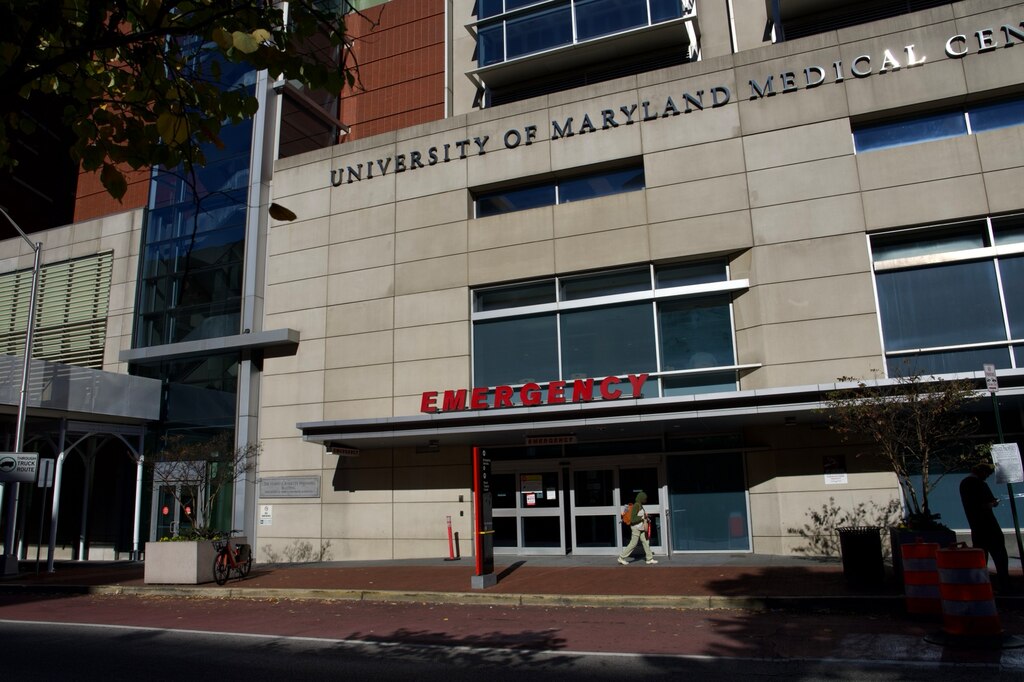
Michael Schwartzberg, a spokesperson for the Baltimore medical center, said in a statement that officials have tried to address the problem by collaborating “internally and externally to improve patient flow” and have focused on how the emergency room delivers care.
Early results at the University of Maryland Medical Center show wait times improved 50% to 10 minutes before a patient is initially seen. Far fewer patients are leaving without being evaluated, he added.
Overall, even while the number of patients has grown, wait times from arrival to discharge have fallen 28% this year compared to last year, he said.
The Maryland Hospital Association said in a statement that all the hospitals are addressing ER wait problems. Sinai Hospital in Baltimore, for example, just spent $50 million to double the size of its emergency department.
But the association said hospitals face other challenges.
“The report makes clear that long ED wait times are a symptom of factors across our health care system, especially the lack of post-acute capacity,” the statement said. “When inpatient beds are full and post-acute facilities cannot accept patients who are medically ready for discharge, emergency departments back up, and patients wait longer than they should.”
Joe DeMattos, a health care consultant who previously led a statewide trade association for assisted living and nursing homes, acknowledged systemwide issues. But he said everyone ought to be looking upstream.
“The underlying drivers of the bed-availability crisis are gaps in chronic and preventive care that lead to avoidable ER visits,” he said.
One patient advocate said all of this misses a major shortcoming in the emergency rooms themselves.
The report “gives very short shrift to” staffing, said Anna Palmisano, who heads Marylanders for Patient Rights. She analyzed the numbers and found several states better controlled wait times with more staff.
“I find it reprehensible that proper staffing is continually ignored, while hospital executives’ primary goal seems to be protecting their million-plus salaries and bonuses,” Palmisano said.
In Howard County, there may be early signs of progress, at least for people like Kwitkowski.
This year, Kwitkowski said, she gave the Howard emergency room another try when her son needed urgent medical attention. The 56-year-old was struck by an empty waiting room and wondered if it was time to stop going to hospitals outside the county.
“It’s a long way to go when you’ve got a family member in the hospital,“ Kwitkowski said. ”I’d rather be close to home.”


Comments
Welcome to The Banner's subscriber-only commenting community. Please review our community guidelines.