You know that line in “Old Town Road” where Lil Nas X sings “Can’t nobody tell me nothing?”
That’s how I felt about 20 years ago when one of my daddy’s Arkansan cousins compared my baked macaroni and cheese to the late, talented Arnell Streeter’s: “You can burn like your Grandma!”
Starting in my late 20s, I had accepted the mantle of recreating her version of the decadently gooey and crispy Southern classic, a staple so important in many Black American families that if yours is nasty, you’re gonna be on plastic plate and napkin duty next year — if they let you back in the house. Holidays are the Big Show, mac and cheese wise.
“Macaroni and cheese is wildly important. You see the debate online with people saying, ‘We never had mac and cheese,’ but I don’t understand how the plate was complete without it,” said food influencer and host Tim “Chyno” Chin, also known as The Baltimore Foodie.
Chef Damian Mosley of Baltimore’s Blacksauce Kitchen thinks the title of macaroni and cheese maker is up there with who makes the greens and sweet potatoes — and it can be up to the family whether the honor is short-lived or permanent. “Does the position change hands?” he asked. “Is your auntie’s mac and cheese always the mac and cheese, like a Supreme Court justice?”
Read More
You laugh, but this is a thing, akin to who in your Italian family gets Nonna’s sauce recipe. As honored as I was to be trusted with the bubbly, cheesy noodles, I stopped making the dish about a decade ago, first because of my veganism and then because of some lactose sensitivity issues after I tried to eat cheese again. I either went to other people’s homes where someone made it and I didn’t eat it, or we went without. (Scandal!)
But this year, with the future of our very culture and country in jeopardy, I suddenly needed to reclaim a tangible reminder of family heritage and history.
Mac and cheese was especially important to me because a lot of Grandma Streeter’s specialties were pork-based and since I was raised without red meat or pork, I couldn’t eat them. I remember asking her for the macaroni recipe for a column I wrote for The Diamondback newspaper at the University of Maryland in college and realizing it was based on vibes, not tablespoons.
“How much cheese?”
“You’ll know.”
“How much butter?”
“Enough.”

After my grandmother died and I started hosting Thanksgiving in my first house in York, Pennsylvania, my Aunt Dorothy (Grandma’s daughter) talked me through it with actual measurements, though experienced cooks learn to eyeball it. She also explained that I was going to have to ignore the ’90s-era impulse to make it light and leave out butter.
Not having a recipe is a staple of a lot of cooks. “You don’t have the actual measurements. They can’t really write it out for you,” Chin said. But a good rule is butter — and lots of it — some sort of milk or cream and, of course, “all the cheeses,” he said. ”Put as much in there as you want. You bought seven pounds of cheese? It’s all going the hell in.”
And when you go all in, you’d better be sure in your abilities.
“There are some things you don’t want messed up,” said Mosley, who was “terrified” at first to approach it at Blacksauce. “Across the board there’s never, like, one mac and cheese everyone likes,” he said. ”It needs to be battle-tested and perfected. You’ve got to know how it’s gonna come out.”
There’s been a lot of internet chatter this holiday season about how to properly mac and cheese (yes, I’m using it as a verb). A lot of those questions stem from the main ingredient: the cheese itself.
What kinds do you use and how much? Chin suggests eschewing pre-shredded and grating it yourself if possible because the anti-caking agents used to stop cheese from sticking to itself can impede melting.
But should you make a cheese sauce? Do you use eggs? Do you make a roux with flour? Mosley makes a bechamel sauce, sometimes with half-and-half and other times with heavy cream.
Macaroni and cheese is “an inexpensive dish that tastes expensive,” Chin said. Well, it’s inexpensive unless you go big with the cheeses.
“That’ll upset the elders. They never had a smoked gouda nothing!” he said. “A block of colby. Start with that. It takes a lot of patience and love. It doesn’t need 1,000 herbs and spices. Pepper. Salt.”

Of course there’s no universal Black holiday meal. For instance, I was raised in Baltimore, but by Prince George’s County natives. I attended most holiday meals with that side of the family, so I had never heard of sauerkraut as a Thanksgiving staple until my Aunt Ann married a Baltimorean.
But tradition is so important to me — the kind you can taste and feel and use to conjure the ones who taught you and went on to leave you to it.
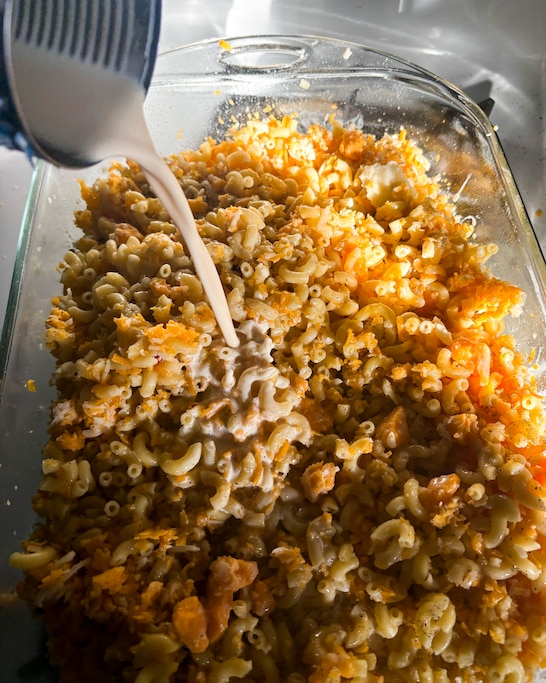
I took this so seriously this Thanksgiving that I decided to make a test batch ahead of time because I was nervous I wouldn’t remember how to do it. I recalled specific things: macaroni, three kinds of cheese which I will keep secret as a nod to my family, evaporated milk, no eggs, and just salt and pepper. But the recipes I consulted for a reference about assembly didn’t match my memory.
So I closed my eyes, shut up and literally listened for Grandma and Aunt Dorothy to walk me through it. And they did. Suddenly, I just knew what to do. Macaroni on the bottom, layered with the cheese right there in the pan, peppering the heck out of it, mixing in the milk to get it all combined and topping with an obscene amount of cheese.
It worked. “That’s it!” my mother said on Thanksgiving. So I am doing it again for Christmas at my sister’s. Aunts from the other side of the family are coming, so it might not be the only version.
But it will be my Grandma Streeter’s. And she’ll be there.
She’s gonna talk about me, but she’ll be there.


Comments
Welcome to The Banner's subscriber-only commenting community. Please review our community guidelines.